
Investigate the experience. Follow the information.
We don't dismiss unusual experiences. We don't automatically label them paranormal either. We investigate them.
The Investigation Sequence
Nine stages. One honest process.
- 01
Listen
- 02
Research
- 03
Consider
- 04
Investigate
- 05
Measure
- 06
Observe
- 07
Review
- 08
Analyze
- 09
Report
Four perspectives. One investigation. No predetermined conclusion.
In Detail
Each stage, examined carefully.
Listen and document
We begin with the experience. Interviews, observations, and a clear timeline help us understand what was reported without assuming its cause.
Research the location
Historical research, environmental information, and relevant leads provide context. We look for inconsistencies and consider ordinary explanations.
Consider ordinary explanations
Before reaching for a paranormal conclusion, we consider plumbing, electrical, structural, environmental, and psychological factors that could account for the experience.
Investigate on site
A walkthrough and documented observations guide the use of equipment and the focus of the investigation.
Document environmental conditions
Temperature, electromagnetic fields, and other environmental conditions are recorded so that readings can be evaluated in context.
Use appropriate investigative equipment
Digital voice recorders, infrared cameras, EMF meters, thermal imaging, and digital thermometers are used where appropriate. Equipment readings are not automatically evidence of paranormal activity.
Consider spiritual impressions
Intuitive observations may offer another perspective. They are recorded and considered alongside other information, not accepted as scientific proof.
Review recordings and observations
We evaluate recordings, images, environmental readings, and reported experiences carefully and methodically.
Separate observation from interpretation
We distinguish what was observed from what it might mean. An unusual reading is an observation; its cause is an interpretation that must be earned, not assumed.
Share findings honestly
We discuss what can be documented, which explanations remain possible, and whether further investigation is appropriate. An unexplained result does not require a paranormal conclusion.
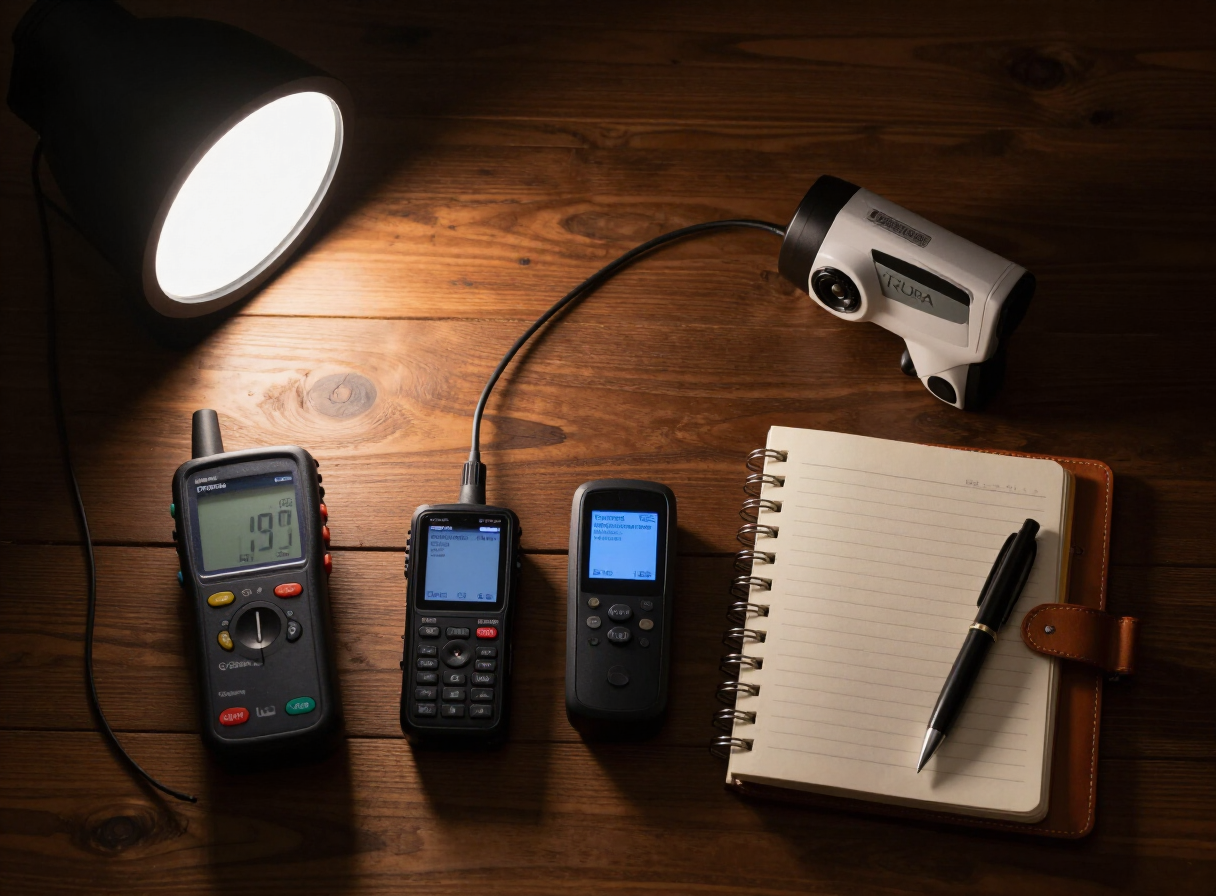
Equipment
Tools for documentation, not proof
Equipment can document unusual conditions. Interpretation requires context.
An EMF reading is not evidence of a spirit. An EVP is not automatically proof of communication with the dead. An intuitive impression is not scientific proof.
Investigation Tools
Categories of equipment
Digital Voice Recorders
Used to capture audio during an investigation. Reviewers listen for unexplained sounds or possible electronic voice phenomena (EVP). An EVP is not automatically proof of communication with the dead.
Infrared Cameras
Allow recording in low-light conditions where visible light is limited. They document the environment, not proof of the paranormal.
EMF Meters
Measure electromagnetic fields. An EMF reading is not automatically evidence of a spirit; many ordinary sources produce electromagnetic fields.
Thermal Imaging
Displays surface temperature differences. Thermal imaging can show temperature variations, but a temperature change is not automatically evidence of paranormal activity.
Digital Thermometers
Record ambient and surface temperatures over time so that changes can be evaluated in context.
Photography & Video
Still and video documentation of the location, conditions, and anything observed. A photograph records what the camera captured. It does not interpret itself.
Other Investigative Technology
Additional tools may be used where appropriate, always in service of careful documentation rather than manufacturing a conclusion.
Evidence Review
What a reading is—and what it isn’t
An EMF reading is not automatically evidence of a spirit.
A temperature change is not automatically evidence of paranormal activity.
An EVP is not automatically proof of communication with the dead.
An intuitive impression is not scientific proof.
Experiencing something you can’t explain?
We take unusual experiences seriously without assuming we already know what caused them. Reach out to discuss your situation in confidence.